Insights
From Reporting to Performance: What CEOs Are Saying About Sustainability as a Growth Strategy
Sustainability is no longer sitting in CSR reports.
It’s sitting in the CEO’s strategy deck.
To understand this shift, it’s worth looking at what some of the world’s leading CEOs are actually saying, and how they are positioning sustainability within their organisations.
Across industries, from finance to technology to manufacturing, leaders are reframing sustainability not as a compliance exercise, but as a driver of growth, resilience, and long-term performance.
And the data backs this up.
Research from the United Nations Global Compact and Accenture shows that 88% of CEOs believe sustainability is critical to business success.
This isn’t a niche view.
It’s the mainstream position.
Sustainability has become a growth conversation
When Paul Polman, CEO of Unilever stated that businesses integrating sustainability into their core strategy “will be the ones that thrive,” it marked a clear shift in thinking.
This wasn’t about responsibility.
It was about competitiveness.
Similarly, Mary Barra of General Motors has framed the transition to electric vehicles as a long-term growth opportunity, not a regulatory burden.
This perspective is reinforced by research from McKinsey & Company, which shows that companies embedding sustainability into operations can outperform peers while unlocking cost efficiencies.
Sustainability is no longer separate from growth strategy.
It is increasingly how growth is being delivered.
From ethical issue to financial reality
The shift becomes even clearer when viewed through a financial lens.
Larry Fink of BlackRock put it bluntly:
“Climate risk is investment risk.”
This reflects a broader market transformation.
According to the Global Sustainable Investment Alliance, over $30 trillion in assets are now managed using sustainable investment strategies.
Sustainability is no longer just about brand or reputation – it’s now embedded in:
- Capital allocation
- Valuation
- Investor expectations
For businesses, this means sustainability performance is directly linked to access to capital and long-term value creation.
Resilience is now a CEO priority
Beyond growth and finance, sustainability is also being framed as a resilience strategy.
Satya Nadella, CEO of Microsoft has positioned sustainability as central to long-term resilience and innovation.
And Indra Nooyi of PepsiCo captured the systemic nature of the challenge:
“You can’t have a healthy business in an unhealthy world.”
This is also being driven by external pressure.
Research from Nielsen shows that 73% of consumers are willing to change their consumption habits to reduce environmental impact.
Sustainability is no longer about doing less harm.
It’s about ensuring businesses can continue to operate, and compete, in the future.
The gap: ambition vs. execution
While CEO rhetoric has evolved, execution remains a challenge.
Many organisations now:
- Commit to net zero
- Publish sustainability reports
- Respond to regulatory requirements
But they often struggle to translate this into measurable business value.
According to Boston Consulting Group, only around 10% of companies fully achieve their sustainability targets.
The core issue isn’t intent.
It’s infrastructure.
Most sustainability tools stop at reporting, producing static outputs that satisfy compliance requirements but fail to inform decisions.
And this is where the disconnect emerges.
From compliance to performance
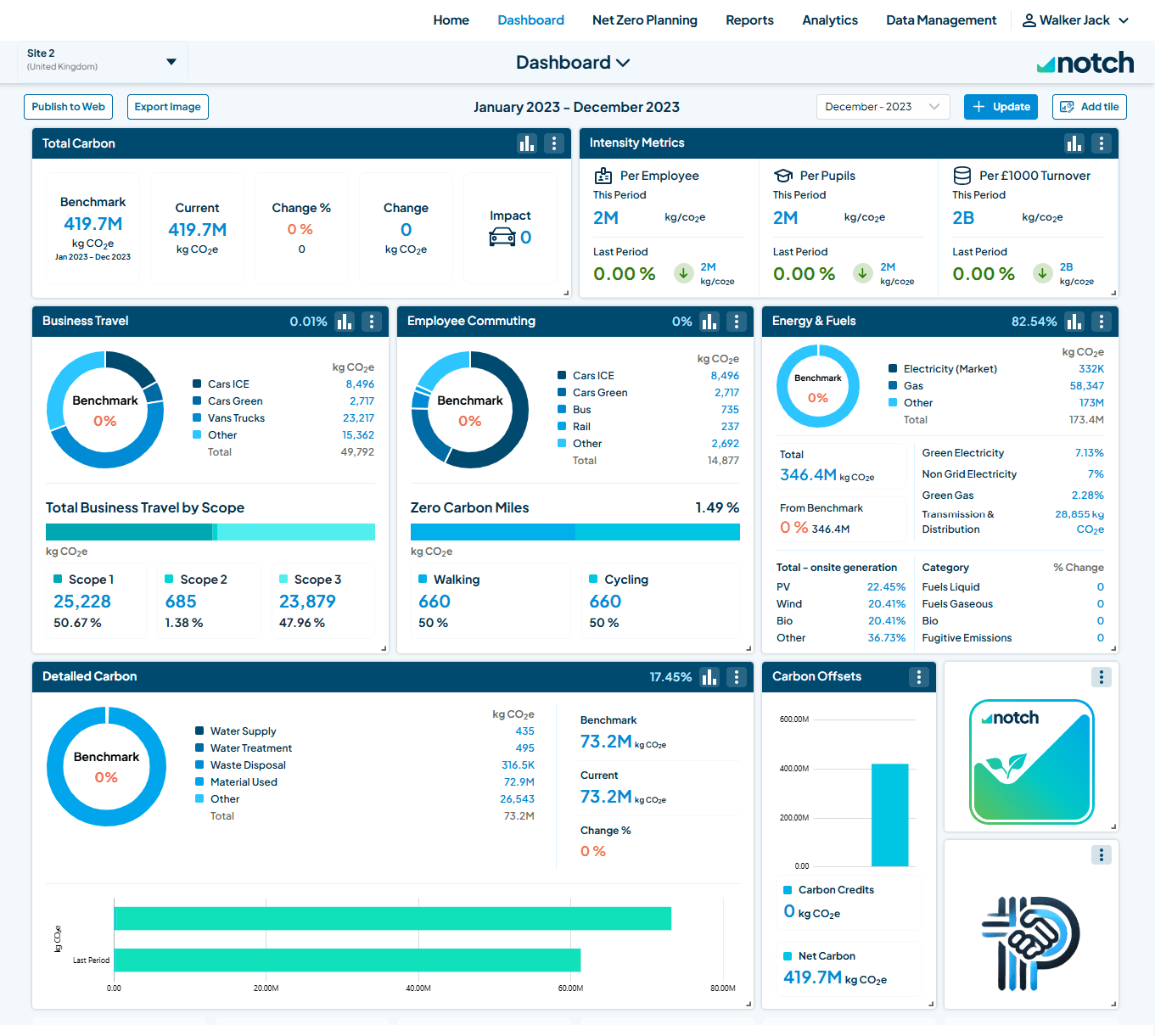
At Notch, we see sustainability differently.
Not as a reporting obligation, but as a source of operational insight.
Because the reality is:
Sustainability data is only valuable if it improves decisions.
Most organisations enter sustainability through compliance:
- Responding to supply chain pressure
- Meeting regulatory requirements (SECR, PPN 06/21, Carbon Reduction Plans)
- Producing reports
But that’s just the starting point.
Turning sustainability data into business value
When sustainability data is connected to real operations, it becomes a powerful tool for improving performance.
This is the shift from:
- Reporting → Insight
- Data → Decisions
- Compliance → Value
As outlined in the Notch model:
Compliance creates the data. Performance creates the value.
There is also a clear commercial upside.
According to the Carbon Trust, businesses can reduce energy costs by 10–20% through efficiency improvements.
With the right system in place, organisations can:
- Identify inefficiencies
- Reduce unnecessary cost
- Improve operational performance
- Make better commercial decisions
Sustainability stops being a cost centre – and becomes a driver of efficiency and growth.
Why this matters now
The direction of travel is clear.
CEOs from companies like Unilever, BlackRock, Microsoft, General Motors, and PepsiCo are aligning sustainability with:
- Growth strategy
- Financial performance
- Long-term resilience
But to deliver on this, organisations need more than ambition.
They need usable, decision-ready data.
The emerging operating model
Sustainability is not a separate function.
It is becoming part of how businesses operate.
Much like financial data, sustainability data is moving towards becoming:
- Embedded in decision-making
- Connected to operations
- Essential for performance management
This is the shift from sustainability as reporting…
To sustainability as a business operating system.
Final thought
The question is no longer whether sustainability matters.
The CEOs, and the data, have already answered that.
The real question is:
Can your business turn sustainability data into better decisions?
Because the organisations that can…
Will be the ones that don’t just comply – but outperform.
Recent News

Why UK CBAM is becoming a financial planning issue.
September 9, 2026-
Bringing it all together: Building a CBAM Ready Organisation
August 4, 2026 -
Leading your organisation through UK CBAM
July 30, 2026



Make your business Net Zero
When it comes to tackling climate change, your business has a big part to play. Notch can help you start your journey towards Net Zero.

Make your business Net Zero