Why some organisations will struggle with supplier emissions data... and others won't
Supplier & Emissions Data is the third capability within The Six Capabilities of CBAM Readiness™. It helps organisations understand, improve and build confidence in the emissions information that underpins CBAM compliance.
The introduction of UK CBAM represents a significant operational change for many importing businesses. Alongside the commercial pressures they already face, organisations are now being asked to understand new reporting requirements, engage suppliers in different ways and gather information that many have never previously needed.
Within The Six Capabilities of CBAM Readiness™, Supplier & Emissions Data is often the point where organisations realise that CBAM extends well beyond their own business. Understanding your imports is one thing. Understanding the emissions information that sits behind those imports requires engagement across your supply chain, and that introduces a very different operational challenge.
The first question is perhaps the most important.
How confident are you in the supplier emissions information your organisation is relying upon?
Most organisations cannot answer that immediately, and that is entirely understandable. UK CBAM introduces information requirements that many businesses have never previously had to manage. Before that question can be answered with confidence, organisations first need to understand what supplier emissions data actually represents and why it deserves far more attention than simply becoming another figure in a spreadsheet.
For businesses operating in competitive markets, this is understandably seen as another layer of compliance requiring time, resource and management attention. That is the reality many organisations are facing today. The practical challenge is understanding the regulation well enough to respond in a way that is organised, proportionate and avoids unnecessary disruption to the day-to-day operation of the business.
It starts by knowing who you need to ask
Supplier engagement is often discussed as though it begins with requesting emissions information.
In practice, that is rarely where the work starts.
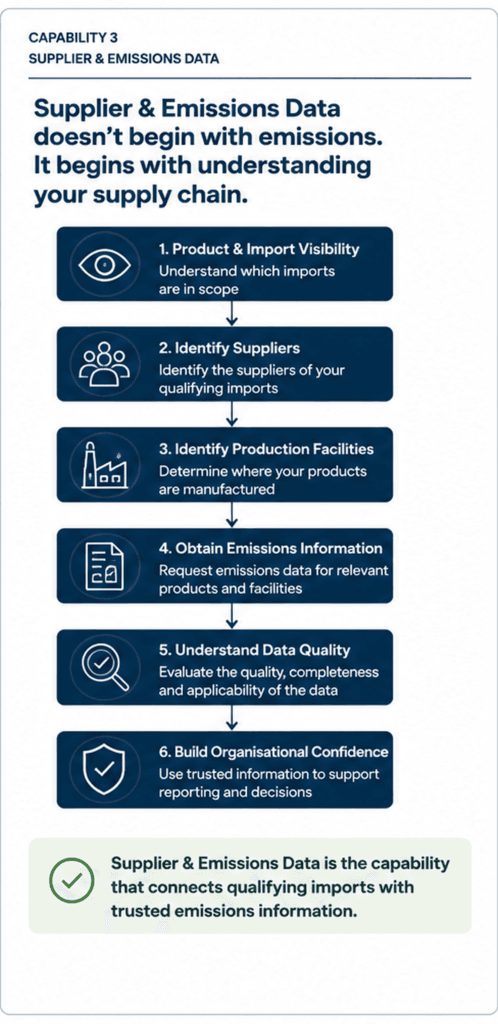
Before approaching suppliers, organisations first need to understand which imported products fall within the scope of CBAM and which suppliers actually manufacture those products. Many businesses source similar products from multiple suppliers. Some suppliers manufacture products across several production facilities, while others act primarily as distributors or trading companies.
Very few supply chains remain static for long. Suppliers change, manufacturing moves between facilities, products evolve and commercial decisions are made every day for perfectly good business reasons. CBAM doesn’t stop that operational reality. It simply means organisations need better visibility of the consequences.
The temptation is often to contact every supplier at once.
That usually creates more activity than progress.
Organisations are generally better served by first understanding where their exposure actually exists before beginning conversations across the supply chain. Once that picture is clear, supplier engagement becomes focused, prioritised and considerably more productive.
This is precisely why Product & Import Visibility precedes Supplier & Emissions Data within the framework.
The next question naturally follows.
Do you know which suppliers and which production facilities manufacture your qualifying imports?
That distinction matters because emissions are generated by manufacturing activities, not by supplier names on a purchase order.
Supplier emissions data is more than a number
It is easy to think of supplier emissions data as another value that needs to be entered into a report.
In reality, every emissions figure has a story behind it.
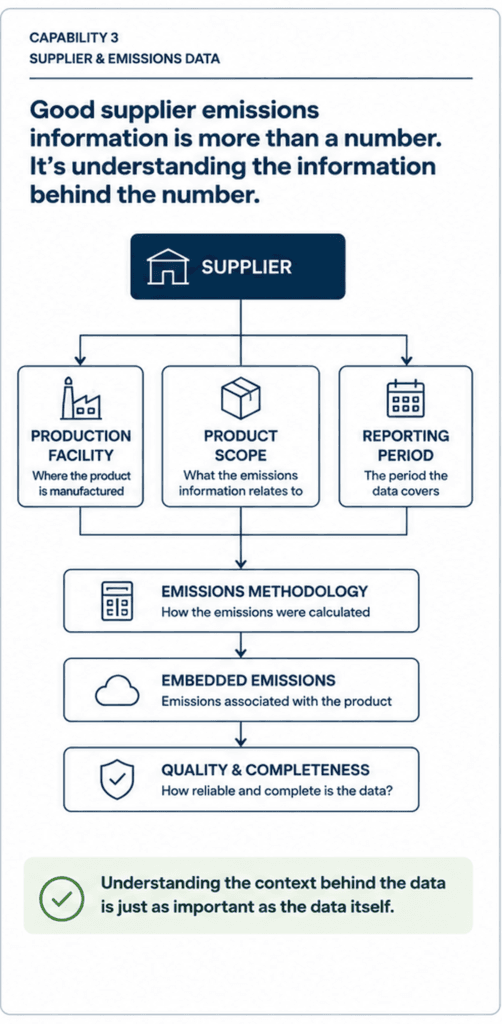
It reflects a manufacturing process, a production facility, a reporting period and the methodology used to calculate the embedded emissions associated with a particular product. Understanding that context is every bit as important as understanding the number itself.
Imagine receiving three quotations for the same product. Very few organisations would compare prices without first understanding what each quotation actually included. Delivery terms, quality standards, payment conditions and warranty arrangements all influence the value of the offer.
Supplier emissions information deserves exactly the same level of scrutiny.
The emissions figure only becomes meaningful when you understand what it relates to.
If two suppliers manufacture the same product using different production facilities, should you expect the emissions to be identical?
The answer is often no. Different manufacturing processes, technologies, energy sources and production methods can all influence embedded emissions. Understanding the context behind the data is therefore just as important as obtaining the data itself.
Building the picture
Supplier capability is unlikely to develop at the same pace across every supply chain.
Some manufacturers are already producing detailed emissions information as part of their normal operations. Others are only beginning to understand what will eventually be required of them. Most organisations will therefore find themselves managing a mixture of mature, developing and incomplete supplier information for some time.
Building supplier emissions information is rather like assembling a large jigsaw puzzle.
Every supplier contributes another piece.
Some pieces arrive quickly.
Some take much longer.
Occasionally, pieces are missing altogether.
The objective is not to celebrate the pieces that have arrived. It is to understand the picture they create and, just as importantly, recognise the areas where the picture remains incomplete.
There is sometimes an expectation that organisations should have complete supplier emissions information from the outset.
For many businesses, that simply isn’t realistic.
What matters is understanding where the information is strong, where it is still developing and where further engagement should be prioritised. Knowing where the gaps exist allows organisations to make sensible decisions about where to focus their effort rather than treating every supplier and every product as though they present the same level of risk.
How much of your current understanding is based on supplier-specific information, and how much still relies on assumptions?
That is a useful question for every organisation to consider.
Every decision begins with information
Every management team makes decisions using the best information available at the time.
Whether preparing financial forecasts, negotiating supplier contracts or planning investment, the credibility of those decisions depends upon the quality of the information on which they are based.
Supplier emissions data should be viewed in exactly the same way.
Imagine asking your finance team to prepare next year’s budget knowing that a significant proportion of the underlying figures were incomplete or still awaiting confirmation. Most organisations would recognise immediately that the forecast could only ever be as reliable as the information used to produce it.
The same principle applies to CBAM.
Incomplete information does not necessarily prevent organisations from moving forward, but it should influence the level of confidence they place in the decisions they make.
Good management is rarely about waiting for perfect information.
It is about understanding the quality of the information available and making informed decisions accordingly.
If somebody asked today how reliable your current supplier emissions information is, how would you answer?
That question sits at the heart of this capability.
Developing capability rather than simply chasing information
It is very easy to become focused on collecting more data.
More spreadsheets.
More supplier declarations.
More responses.
But quantity is not the objective.
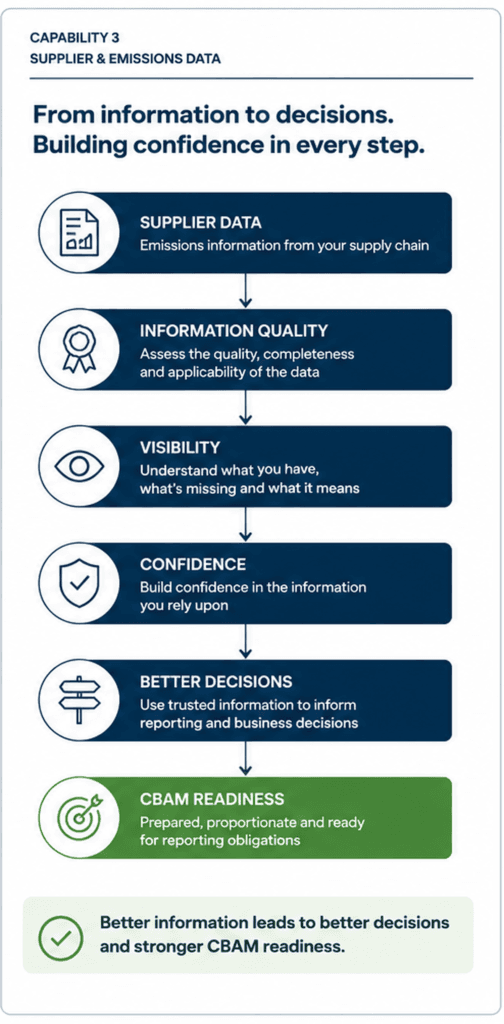
The objective is reaching a point where management understands the strengths and limitations of the information available to the organisation and can make informed decisions accordingly.
Perfect information is rare in business.
Understanding the quality of the information you already have is often far more valuable.
Businesses don’t stop changing because new regulations arrive. Suppliers change. Manufacturing locations change. Products evolve. Markets move. CBAM readiness is therefore not about creating a perfect snapshot of today’s supply chain. It is about building the capability to keep pace with tomorrow’s changes.
That is what Supplier & Emissions Data is designed to achieve.
Not simply another compliance activity.
An operational capability that enables organisations to understand their position, reduce unnecessary uncertainty and prepare for CBAM in a structured, practical and proportionate way.
Reflect on your own organisation
Supplier & Emissions Data is one of the six operational capabilities that together determine CBAM readiness.
As you reflect on this capability, perhaps the most important question is also the simplest.
Are you making important decisions using information you genuinely understand?
The CBAM Readiness Assessment has been designed to help organisations answer that question across all six capabilities. In around five minutes, it provides a structured assessment of your current readiness, identifies practical areas for improvement and helps you prioritise the next steps on your CBAM journey.
Understanding your position is always the first step towards improving it.
About James Napier
James Napier is the founder of Notch, an author and sustainability expert specialising in carbon regulation and operational readiness. He is the creator of The Six Capabilities of CBAM Readiness™, a practical framework designed to help organisations build the leadership, data, financial, reporting and workflow capabilities needed to manage CBAM with confidence.
Through his work with importers, manufacturers and professional advisers, James focuses on helping organisations move from regulatory awareness to operational readiness, creating the visibility needed for confident reporting, stronger financial planning and better commercial decisions.
Recent News

Why UK CBAM is becoming a financial planning issue.
September 9, 2026-
Bringing it all together: Building a CBAM Ready Organisation
August 4, 2026 -
Leading your organisation through UK CBAM
July 30, 2026



Make your business Net Zero
When it comes to tackling climate change, your business has a big part to play. Notch can help you start your journey towards Net Zero.

Make your business Net Zero