Product & Import Visibility:
Why Knowing You Are in Scope is Not Enough
The first operational test of CBAM readiness is not whether an organisation understands the regulation. It is whether it can identify the right goods, see where exposure is accumulating and understand what is driving it.
by James Napier
For UK CBAM, £50,000 is an important number.
It is the minimum registration threshold and, understandably, many businesses will focus first on a simple question: are our CBAM imports above or below it?
But there is a problem.
A threshold test is only as reliable as the product visibility behind it.
If relevant goods are spread across product records, business units, customs declarations and agents, a business may not realise that several apparently modest product lines are accumulating towards the threshold. Broad-brush screening can create the opposite problem, pulling the wrong goods into the analysis and overstating the organisation’s position.
Poor visibility can create false confidence.
A business could believe it sits comfortably below the threshold, only to discover later that qualifying imports were missed or incorrectly classified. By then, it may be trying to reconstruct months of import activity, trace suppliers and facilities, establish the emissions basis behind affected goods and understand obligations it should have been preparing to manage earlier.
Or it could spend significant time and money preparing around the wrong population of products.
Neither is a comfortable position for an organisation to be in.
And crossing the £50,000 threshold is still only the start. It tells you that a statutory line has been crossed. It does not tell you which product lines are driving exposure, where financial risk is concentrated, which suppliers matter most or what action should follow.
That is where Product & Import Visibility becomes an operational capability.
It is one of The Six Capabilities of CBAM Readiness™, and one of the first real tests of whether an organisation is moving from regulatory awareness to a position it can actually manage.
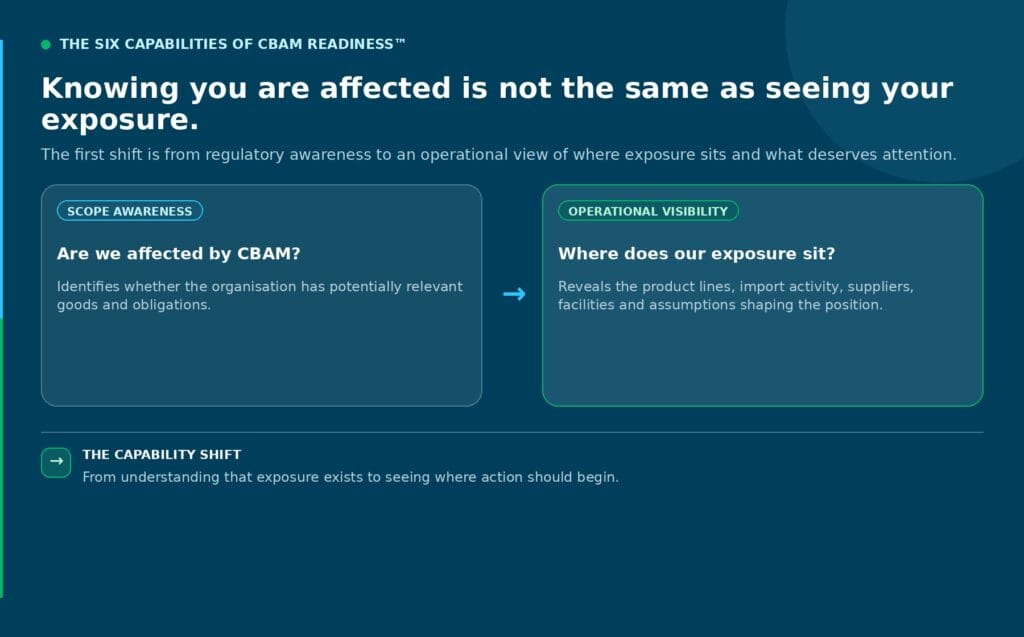
“We know we’re in scope” is not a readiness strategy.
This is particularly easy to miss in a mid-sized importing business.
A company may buy a range of components and materials through different suppliers and use more than one customs agent. No individual product line looks especially significant, so the overall position appears manageable.
But several qualifying lines may be accumulating at the same time.
One sits within a larger product category. Another is known internally by a commercial description that gives little indication of its customs classification. A third enters through a different business unit.
Individually, none attracts much attention.
Together, they may tell a very different story.
This is the risk of looking at CBAM only from the top down. An organisation may understand the regulation and still fail to see its own position clearly enough to know when action is required.
The problem continues after the threshold has been crossed. A business may know it is within the regime and even have an initial liability estimate, but still be unable to explain what is driving that number.
I think of it like being told that your energy bill has increased by 30 per cent without being able to see which sites, buildings or operations caused the increase. The headline matters, but it does not tell you where to act.
Knowing you have exposure is not the same as being able to manage it.
Your data probably exists. The problem is that it does not exist together.
One of the most common assumptions about CBAM readiness is that the answer must be more data. Sometimes it is. But often the first problem is fragmentation.
Procurement knows what the business buys and from whom. The customs agent holds declaration data. Finance understands values and volumes. Sustainability teams may hold emissions information. Suppliers provide data through separate channels.
Each piece can be correct and still fail to create a usable CBAM picture.
Take a typical imported product. Internally, the business knows it by a product code and commercial description. The customs declaration contains a CN code. Procurement knows the supplier. Emissions information may relate to a specific production facility. Finance needs to understand how all of this contributes to potential liability.
The problem may not be missing data. It may be missing visibility.
Product & Import Visibility is the ability to connect those pieces into a position the organisation can understand, explain and manage.
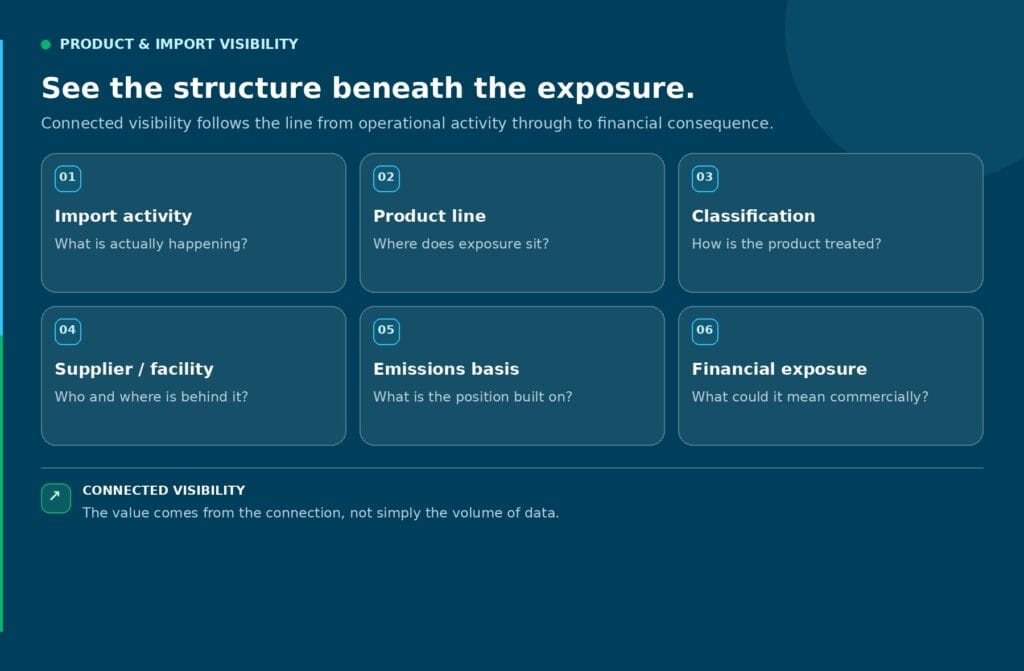
This operational reality has shaped how we have built Notch CBAM.
The platform uses a product-line-first architecture because a corporate total, on its own, is not enough. Import activity, classifications, suppliers, facilities, emissions intelligence and financial exposure need to remain connected at the level where the underlying position can actually be understood.
The aim is not simply to produce a liability number. It is to help organisations see what is driving it, understand what is changing and identify where action could make the greatest difference.
A single liability number can hide the problem you most need to solve.
Take two businesses with the same estimated annual CBAM exposure: £2 million.
In the first, £1.4 million is concentrated in three aluminium product lines sourced from two production facilities. In the second, the £2 million is spread across 250 steel product lines, dozens of suppliers and multiple countries of origin.
The headline exposure is identical.
The operational problem is not.
The first business has concentration. That creates risk, but also focus: a relatively small number of supplier relationships and emissions positions may materially influence overall exposure.
The second has fragmentation. Its challenge may be maintaining classification confidence, acquiring data consistently and managing a large and changing product population.
Same number. Different problem.
A corporate liability figure is like a warning light on a dashboard. It tells you something needs attention, but not what is happening underneath.
Once the structure is visible, the business can ask better questions. Did volumes increase? Did the product mix change? Has a new supplier appeared? Are default emissions values driving the movement?
The financial number matters. The ability to explain it is what enables action.
The supplier making the most noise may not be the one that matters most.
Take a business with 80 overseas suppliers.
Procurement sends questionnaires to all 80 and begins chasing responses. Some reply quickly, some provide incomplete information, others misunderstand the request or do not respond at all. Within weeks, the team is managing a significant exercise.
Then the business maps its exposure and discovers that just five suppliers sit behind most of its forecast CBAM liability.
That changes the problem considerably.
I would want to know that before sending the first email.
The question is not simply where data is missing, but where better data would make the greatest difference. If a handful of product lines account for most forecast liability, the suppliers and facilities behind them may deserve immediate attention. If default values create material exposure in one area but only marginal impact elsewhere, effort should reflect that.
I would rather see a business make meaningful progress with the suppliers behind its most material exposure than spend months chasing every data gap equally.
This is where Product & Import Visibility connects directly to Supplier & Emissions Data. The first shows where exposure sits; the second strengthens the evidence behind it.
Without visibility, supplier engagement can become very busy without being particularly strategic.
A product list is a map. It does not tell you where the traffic is.
A product register matters, but it is still a relatively static view of the business. CBAM exposure is not static.
Volumes change. New suppliers appear. Countries of origin change. Dormant product lines become active again. The underlying product may be exactly the same while the organisation’s exposure moves significantly.
I compare this to a road map. The map tells you where the roads are, but if you are deciding how to make your journey today, you also need to know where the traffic is.
Your product structure is the map. Your import activity is the traffic.
You need both.
As imports arrive, the emissions position and financial exposure move with them. New activity needs to be validated, connected to the right product line and reflected in the changing position.
That is where Product & Import Visibility connects to Workflow Maturity. Without a repeatable process for maintaining visibility, the organisation is always reconstructing a position that has already moved.
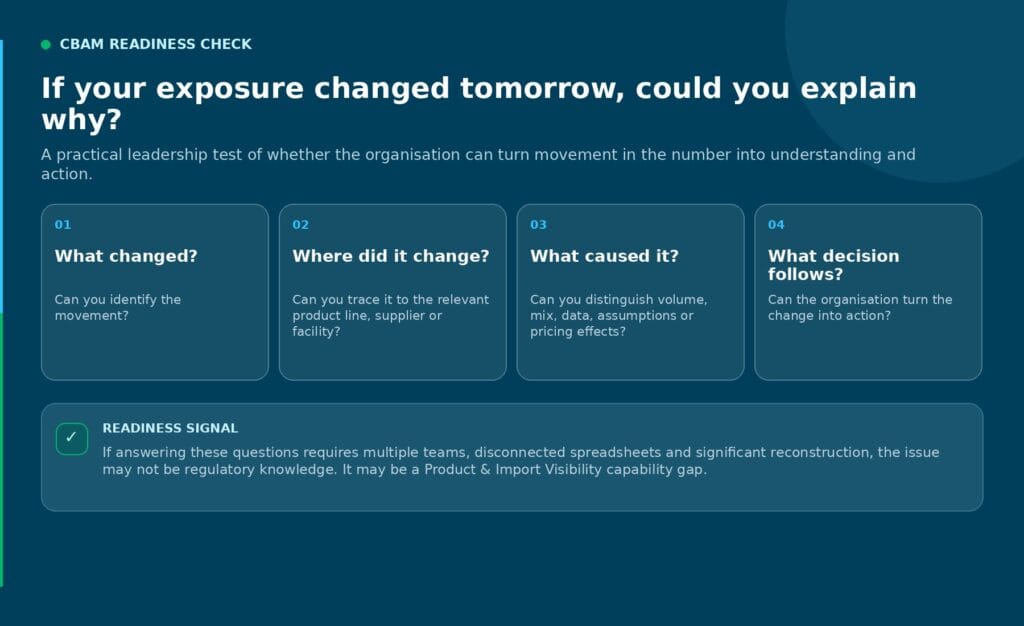
If the number changes tomorrow, can you explain why?
This is one of the simplest practical tests I use when thinking about operational readiness.
If your estimated CBAM exposure changed materially tomorrow, could your organisation explain what changed, where it changed and what caused it?
More importantly, could it decide what action should follow?
A business with strong Product & Import Visibility should be able to investigate movement because the financial position remains connected to the operational activity beneath it.
If answering those questions requires several teams, multiple spreadsheets and two weeks of reconstruction, the organisation may understand CBAM extremely well.
But it does not yet have Product & Import Visibility as an operational capability.
CBAM exposure will not stand still. Operational readiness is not the ability to calculate the answer once.
It is the ability to understand and manage the position as it moves.
The real purpose of visibility is better decisions
Visibility is not the end goal.
The purpose is to improve the decisions that follow.
When an organisation can see where exposure sits, it can focus supplier engagement where better information matters most. It can identify product lines that are particularly sensitive to default emissions values, build more credible liability forecasts and understand where margins may come under pressure.
That visibility can influence pricing, sourcing, supplier intervention and cost recovery. It also strengthens reporting because the organisation is not reconstructing its position at the end of the reporting period. The underlying activity, assumptions and changes have been visible along the way.
This is the wider philosophy behind The Six Capabilities of CBAM Readiness™:
Reporting creates visibility. Visibility creates confidence. Confidence enables better decisions.
The £50,000 threshold matters.
But it is only the beginning.
The more important operational question is whether your organisation can identify the right goods, see where exposure is accumulating and understand what is driving the position.
Because a threshold tells you when CBAM matters.
Visibility tells you what to do about it.
How ready is your organisation?
Product & Import Visibility is only one part of operational readiness.
An organisation may have strong visibility of its imports but unclear ownership. It may understand where exposure sits but still lack reliable supplier and emissions data. It may be building its reporting processes without a credible view of future financial impact, or relying on workflows that will become difficult to manage as activity increases.
That is why I developed The Six Capabilities of CBAM Readiness™:
Leadership & Ownership. Product & Import Visibility. Supplier & Emissions Data. Financial Readiness. Reporting & Audit Readiness. Workflow Maturity.
Together, they provide a practical way to assess whether an organisation is building the capabilities needed to manage CBAM with confidence.
The CBAM Readiness Assessment measures your current position across all six capabilities, highlights where operational gaps may exist and provides a structured starting point for deciding what needs attention first.
Assess your Product & Import Visibility — and see how your organisation performs across all six capabilities.
About James Napier
James Napier is the founder of Notch, an author and sustainability expert specialising in carbon regulation and operational readiness. He is the creator of The Six Capabilities of CBAM Readiness™, a practical framework designed to help organisations build the leadership, data, financial, reporting and workflow capabilities needed to manage CBAM with confidence.
Through his work with importers, manufacturers and professional advisers, James focuses on helping organisations move from regulatory awareness to operational readiness, creating the visibility needed for confident reporting, stronger financial planning and better commercial decisions.
Recent News

Why UK CBAM is becoming a financial planning issue.
September 9, 2026-
Bringing it all together: Building a CBAM Ready Organisation
August 4, 2026 -
Leading your organisation through UK CBAM
July 30, 2026



Make your business Net Zero
When it comes to tackling climate change, your business has a big part to play. Notch can help you start your journey towards Net Zero.

Make your business Net Zero