Insights
Building carbon fluency into the next generation of business leaders.
Carbon accounting is moving from compliance function to commercial capability.
Emissions data now informs capital allocation, procurement strategy, operational efficiency and risk management. It is increasingly embedded in how businesses are valued, regulated and governed.
That shift changes what we should expect from business education.
If carbon data is becoming central to commercial decision-making, graduates cannot enter the workforce with theoretical awareness alone. They need fluency – the confidence to measure, interpret and apply emissions data in real-world business contexts.
Carbon as a Core Business Skill
Sustainability education has long focused on climate science, environmental responsibility and high-level frameworks. That foundation remains essential.
But the market is evolving.
Organisations now require people who can build carbon footprints, understand Scope 1, 2 and 3 emissions, navigate reporting standards and translate emissions data into operational decisions.
Carbon accounting is no longer a niche technical specialism. It is becoming baseline business infrastructure.
As James Napier, Founder and CEO at Notch, explains:
“Carbon measurement is becoming a fundamental business capability. If emissions data is influencing strategy, finance and operations, future leaders need to be comfortable working with it before they enter the boardroom. The theory matters – but the ability to apply it is what changes businesses.”
A Practical Model in Action: University of Exeter
The BSc Business and Environment course at the University of Exeter – internationally recognised for its leadership in climate and environmental research – is demonstrating how this evolution can work in practice.
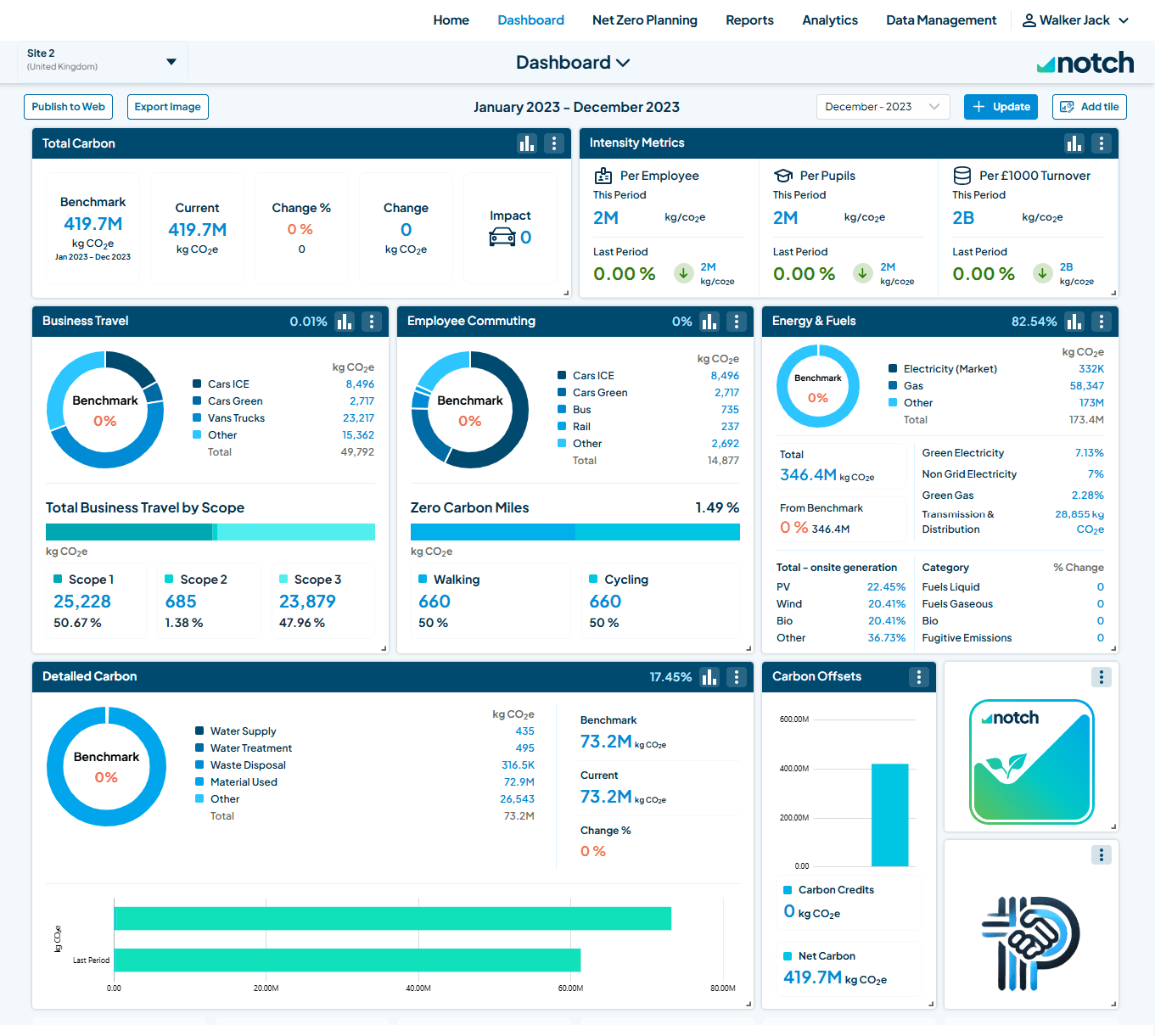
Through a partnership with Notch, our founder and CEO James Napier, guides students to gain hands-on experience producing real, compliant business carbon footprints using the same systems and standards organisations rely on today.
Students are not working on abstract case studies. They are applying carbon accounting methodology to live projects – including Scope 1 carbon footprinting for a local charity.
As one student involved in the programme shared:
“James shared some excellent insights into an incredible platform that is already proving extremely valuable for our current group project, where my group are working on Scope 1 carbon footprinting for a local charity, and which will no doubt be useful in future work as well.
It’s great to have access to such useful tools, especially as carbon accounting and sustainability become increasingly central to the future of business.”
Experiences like this build confidence, technical competence and commercial awareness – closing the gap between academic insight and business application.

Defining the Future of Business Education
As climate risk becomes financial risk, and emissions data becomes operational data, business education must evolve accordingly.
The institutions that embed applied carbon accounting into their programmes today will graduate leaders prepared for how business is actually changing.
At Notch, we are building the infrastructure that makes carbon accounting practical, accessible and decision-ready. Our partnerships with universities are an extension of that mission – helping to shape a generation of commercially fluent, climate-ready leaders.
We are proud to be working with forward-thinking institutions like the University of Exeter.
If your business school or university is exploring how to integrate applied carbon accounting into your curriculum, we would welcome a conversation.
Together, we can build carbon fluency into the next generation of business leaders.
Recent News

Building Carbon Fluency into the Next Generation of Business Leaders
February 18, 2026



Make your business Net Zero
When it comes to tackling climate change, your business has a big part to play. Notch can help you start your journey towards Net Zero.

Make your business Net Zero